
Question:
Answer:
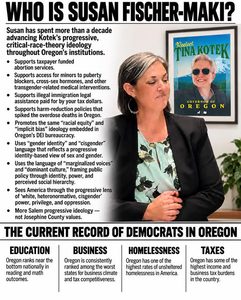
Rep. Dwayne Yunker recently released an attack ad in the SneakPreview and through his campaign social media page titled “Who Is Susan Fischer-Maki?” It contains a long list of statements about what I supposedly believe, what ideology I supposedly represent, and even how I supposedly see America.
The intention behind much of the language is pretty obvious: take complicated and emotionally charged subjects, frame them in the most divisive way possible, and attach them to me.
Underneath the loaded language are subjects people have asked me in earnest during this campaign: abortion, immigration, addiction, transgender healthcare, race, gender and how I think about our government (especially in relation to the promise of government). Those are all legitimate things to ask someone who wants to represent you.
So let me directly address them in good faith, fully knowing that is not how they were published.
“Susan has spent more than a decade advancing Kotek’s progressive, ‘critical-race-theory ideology’ throughout Oregon’s institutions.”
I have no connection to Gov. Kotek or her campaign. My work in Oregon has spanned several governors and several legislatures, and it has always been about children, families, and community health. I have never worked for an organization whose purpose was advancing “critical race theory.” For the record, I do not believe that learning and talking about our full history as a nation detracts from patriotism. I believe it is one of the most beautiful ways we can continue to love our country and contribute to the endurance of democracy. If Rep. Yunker has a specific program or decision of mine in mind, I’m glad to talk about it.
“Supports taxpayer funded abortion services.”
In 2017 Oregon passed the Reproductive Health Equity Act. It makes sure reproductive health care, including abortion, is covered whether or not a person has money or insurance. I support that law. Decisions about a pregnancy belong to a woman, her family, and her doctor. I don’t believe the size of her bank account should decide which of those choices she actually has. Reproductive care is also much more than abortion. It includes prenatal care, birth control, miscarriage care, and emergencies like an ectopic pregnancy.
“Supports access for minors to puberty blockers, cross-sex hormones, and other transgender-related medical interventions.”
This claim most likely points to HB 2002, passed in 2023, and to the Oregon Health Plan’s coverage of gender-affirming care. Decisions about a minor’s medical care belong with that individual, their parents (when possible), and their doctors, not with legislators. That’s true for this care and for every other kind of care. Would I support making this care illegal for families who choose it with their doctor? No. Would I support unrestricted access through school-based health centers without parents involved? No.
In the spirit of full transparency, here’s my own work history. I spent eight years at AllCare Health, a coordinated care organization serving Oregon Health Plan members. My job was not to decide benefits or coverage. My work centered on supporting local organizations that keep our community healthy. Some of them, like public health, provide reproductive health care and follow affirming practices for the people they serve, including gender-affirming practices. I’m proud of that work and of what those partners do for families in southern Oregon.
“Supports illegal immigration legal assistance paid for by your tax dollars.”
Oregon helps pay for lawyers for people facing deportation through programs like Universal Representation, created in 2022, and I support this. Due process is in our Constitution because the government can get things wrong, and when it does, people lose their jobs, their homes, and their families. In immigration court, the government always has a lawyer, but the person facing deportation has no right to a free one. Many of the people this program helps are our neighbors. They work here, go to school here, and raise families here. A fair hearing protects all of us. I also believe every public program should show results for what it costs, and I would hold this one to the same standard as every other.
“Supports harm-reduction policies that spiked the overdose deaths in Oregon.”
“Harm reduction” covers many different practices and I am not a practitioner trained in those. However, as a community member and professional, I have worked alongside and advocated for our local mental health and addiction treatment providers and, for some, harm reduction is a part of the practices they know to provide protection and opportunities for supporting the successful launch of recovery. I stand firmly with those organizations in their choice to utilize evidence informed, community-centered protocols.
If the concern is that Josephine County has experienced an unacceptable number of overdose deaths in recent years, then we are in absolute agreement. Specifically, I believe Measure 110 was poorly designed and implemented, failed Josephine County, and caused tremendous harm to our community. Some of the increased acuity of the challenges we have experienced around addiction, homelessness, and public safety can be traced back to the failures of that policy and its implementation. Our community cannot afford to make another mistake like that.
“Promotes the same ‘racial equity’ and ‘implicit bias’ ideology embedded in Oregon’s DEI bureaucracy.”
Do I work to educate myself about racial equity and implicit bias and try to be aware of them in my work? Yes. Have I worked to become more educated about the ways government systems, including schools, have excluded many individuals (due to their race, gender, disability, religion, or other protected classes)? Yes, again. And, do I seek to be accountable each day to living the values in which I was raised which include loving my neighbor as myself? Yes, always.
My work has afforded me the opportunity to be witness to many attempts by our state government to improve organization and individual level skills at recognizing unhealthy biases, helping our community be anti-racist, and standing against unlawful mistreatment of others. I do not believe all of these have been effective, but the underlying intent is important. Like so many other facets of the current state of our government, this is an area that could be more effectively implemented to achieve better outcomes without such administrative burden and cost.
If the accusation from Rep. Yunker is that I’ve blindly promoted some particular government “ideology,” then show me the policy, program, or action we are talking about. I’m happy to defend what I’ve actually said or done.
“Uses ‘gender identity’ and ‘cisgender’ language that reflects a progressive identity-based view of sex and gender.”
Yes, I use words that are appropriate to the subject I’m discussing. I have spent my career working across education and healthcare, where being able to communicate accurately about complicated issues matters. Using the word “cisgender” isn’t a policy position. If there’s legislation Rep. Yunker wants to debate, let’s debate it.
“Uses the language of ‘marginalized voices’ and ‘dominant culture,’ framing public policy through identity, power, and perceived social hierarchy.”
Yes, I’ve used the words “marginalized voices” and “dominant culture,” and I will use them again when they are relevant to what I’m discussing. Quoting individual words isn’t much of a policy critique. What specific position or decision are we supposed to be debating?
“Sees America through the progressive lens of ‘white, heteronormative, cisgender’ power, privilege, and oppression.”
I see America through many lenses, because our history and our country are complex. We are made stronger as a community and a nation when we grow our ability to talk about our past, present, and future. This does not change that I also believe America is the greatest country on Earth, and part of what makes it great is our willingness to recognize where we have fallen short and keep working toward the ideals we have always claimed for ourselves and for our neighbors.
“More Salem progressive ideology — not Josephine County values.”
Josephine County is my home. I’ve built my family, career, business, and community relationships here, and I’m grateful for the many local residents who have publicly put their names behind my campaign. The ad is hitting the one note their campaign has: try to divide people to maintain power. And I believe this community is wise to those antics.
So I would turn the question around for the benefit of voters and residents here: which Josephine County value is Rep. Yunker claiming I don’t share?
If You Want to Challenge Me, Show Up
Why are we having this conversation through an attack ad and follow-ups from citizens via Facebook?
Rep. Yunker and I are running for the same office. We live in the same community. There are plenty of opportunities to sit in the same room, answer the same questions, and let voters compare our answers.
This month alone, I took part in the CRG candidate forum on September 12th, and the Rogue Valley Council of Governments candidate forum on September 18th. Rep. Yunker did not. And this pattern of not being accessible or simply choosing to stay unengaged in opportunities for civic discourse isn’t new for him.
It does nothing to serve this community to skip those opportunities and communicate through an attack ad filled with culture war talking points and language stripped of the policy context that would allow voters to evaluate them. We are adults asking our neighbors to entrust us with public office. We should be able to sit across from one another and have an adult conversation.
I’m going to keep showing up. I’m going to keep taking questions, including difficult ones. I’m going to keep talking with Republicans, Democrats, independents and people who don’t particularly like either political party. And when someone challenges one of my positions, I’ll do my best to explain what I believe and why.
As a voter, I hope that Rep. Yunker will start to do the same.