
QUESTION:
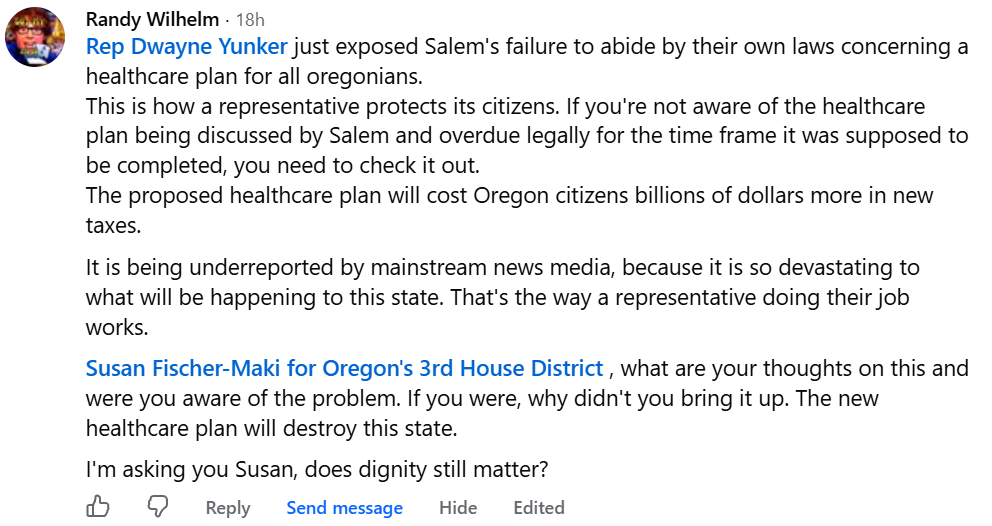
ANSWER:
I believe our health care system needs fundamental redesign, and I say that as a fiscal conservative, because a system that drives people to delay care is the most expensive system of all. But believing in the goal is not the same as approving every plan to reach it. By the state’s own account, the financing for Oregon’s Universal Health Plan is not finished: the committee charged with designing it completed only five of its eight tasks before it was disbanded, and its own members flagged serious gaps in revenue, reserves, and start-up costs.
My caution is not ideological. It is about whether the state can actually deliver a project this complex to a community like ours. I insist that any path forward follow Oregon’s own statutes and rules, including on the overdue December report, with no shortcuts. And I will not let that caution be minimized into the inch-deep, inch-wide politics of fear coming from the current officeholder.
What this is, and where it honestly stands
In 2023, Senate Bill 1089 created a governance board to design how Oregon could finance universal health coverage. That board’s Finance and Revenue Committee worked for well over a year, with a consultant, and produced a serious body of work. It deserves credit for that. But the committee itself, by a five-to-two vote, acknowledged it had finished only the first five of its eight charter tasks and the first of two deliverables before the board disbanded it.
Three of the unfinished pieces are exactly the ones that matter most to working families: the full impact on households and small businesses, the start-up and reserve costs, and an honest before-and-after comparison of what we pay now versus what we would pay under the plan. Three of the committee’s own finance members, including a single-payer supporter, signed a minority report warning that without a complete and vetted revenue, reserve, and capital plan, releasing a tax proposal now is premature and likely understated. When the people building the plan tell you the math is incomplete, you listen.
What I hear across Josephine County
At this point in the campaign, I have had conversations with thousands of neighbors while seeking this office, and in a great many of them, the same theme surfaces without my prompting: health care costs keep climbing, for everyone. I hear it from people with good jobs at large employers who still watch their share of the premium rise every year. I hear it from small business owners who are required to insure their employees and feel the weight of it. I hear it from colleagues in independent and consulting roles like mine, who must buy their own coverage and have watched those premiums climb by thousands of dollars a month. And I hear it from the uninsured, who put off care until a small problem becomes a big problem. That last outcome is not just a human tragedy; it is the single least fiscally conservative thing our current system produces. I am a fiscal conservative in the truest sense: I want our dollars to buy care, quality care matched to what our community actually needs, rather than feeding a system built to sustain itself.
My real concern: can the state deliver it here?
Here is where my professional experience makes me cautious, and it cuts in two directions at once. Too often, the state’s clock and our community’s clock do not match.
Sometimes the state moves too slowly for the need in front of us. Consider community information exchanges, the tools that let frontline workers coordinate care and make services more trauma-informed and client-centered. Those conversations in Salem have been so belabored that the people who would benefit are still waiting, while workers do heroic coordination by hand.
And sometimes the state acts without building what success actually requires. Consider our investment in traditional health workers. Oregon has rightly put real money into training this workforce across its specialty areas. But we did not adequately build the supervision, administrative, that quality services require and that makes those services reimbursable in the first place. And reimbursement rates, though better than they were, still do not reflect what it actually costs to deliver these services in a rural community. So a worthy investment arrives half-built, and when it struggles, it looks like our community failed, when in truth the rollout did.
I have seen this pattern across more than one state agency. This is not every agency, nor every project. But it is common enough that it shapes my judgment. When I weigh a plan to reshape a huge share of our economy against that track record, caution is not obstruction. It is the responsibility of anyone who has watched good ideas land badly on the people they were meant to help.
Process is not a technicality
I believe deeply in the promise of government, which is one of the two reasons I am in this race. That belief is exactly why process integrity matters to me. The Universal Health Plan’s comprehensive report was due by statute on September 15. It is now expected in December, after the election. If an extension is warranted, the lawful path runs through the Legislature, consistent with Oregon’s other statutes and rules, and that path should be followed, period.
I hold the same objection to last-minute legislative maneuvers that delay or weaken already-enacted laws, as we saw this year when an 84-page amendment rewriting Oregon’s 2024 campaign finance law was posted less than a day before its hearing, drawing warnings from reform advocates that it came “very close to making the contribution limits and disclosure requirements illusory.” Government earns public trust by following its own rules, especially when the stakes are high and the timing is inconvenient.
What I am asking for
Finish the financial review with the revenue, reserve, and start-up numbers the committee’s own members said are missing so that everyone can make an informed decision. Follow the law on timelines and process, without exception. And bring communities like ours into the design before the decisions are made, not after. Rural southern Oregon cannot be an afterthought in a plan this consequential.
I will not pretend the status quo is acceptable; it is bankrupting families and it is, by any honest accounting, inefficient. And I will not join those who exploit legitimate caution to stoke fear while offering nothing. We can want better and demand that better be built competently, lawfully, and with us, not to us. That is the standard I will hold in Salem.